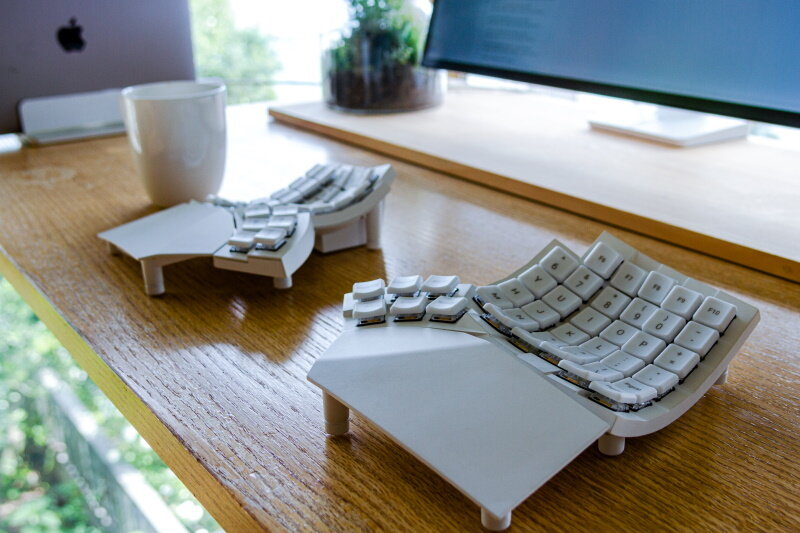
Day 28 Post Kickstarter
about 4 years ago
– Thu, Mar 24, 2022 at 03:45:07 AM
This is our first Backers Update. It has been an incredibly busy 28 days since the end of the Kickstarter campaign.
Backer Survey
We are using Backerkit Pledge Manager to help manage the pledges. Pledge management is anything but simple. Do you know there are a whopping 48 variations of Glove80 that we will ship for this Kickstarter?
If you are backer of the Glove80 Kickstarter Campaign, you will soon receive (if you have not received already) an invitation email to Backerkit to customize the Glove80(s) you have backed. You have until 24 April 2022 to make your choices and fill in the backer survey.
Please note that if we have not received your filled-in backer survey by 24 April 2022, you will receive the default choice of Glove80, which is a Standard Edition white case with labeled keycaps and soldered red switches.
Pre-order store
If you missed your chance of participating in the Glove80 Kickstarter campaign, fret not.
We are releasing a limited quantity of Glove80s in our first production batch through the Backerkit Pre-Order store.
Add-Ons
By popular demand we have added a few accessory items for Glove80, including the quick release tripod mount connector plates. The add-ons are available either through the Backer Survey or the Pre-Order store.
(Demonstration of the Quick Release Tripod Mount Connector Plates)
Standard Edition and Gamer Edition
Glove80 comes in two forms. The Standard Edition was originally supposed to have 18 LEDs on the left hand, and the Gamer Edition has LEDs under all 80 keys.
Some of you may recall that that Gamer Edition was originally a Kickstarter stretch goal. Having two separate PCB designs and related certifications add a big overhead cost, and so we needed a stretch goal to make that happen.
However we figured out a way to make Gamer Edition happen without reaching the stretch goal. With the new arrangement, the Gamer Edition and Standard Edition are now sharing the same PCBs. The Standard Edition now has all 40 LEDs populated on the left hand: in other words, backers of Standard Edition are now getting a free upgrade of 28 extra LEDs.
Needless to say, the 28 extra LEDs in the Standard Edition do add to our bill of material (BOM) costs. In our private conversations, some backers expressed a wish to contribute to the extra BOM costs. This is not necessary, but if you’d really like to, a small tip is always appreciated.
Progress - Injection mold
Our highest priority job is to finalize the plastic design and begin the production of the injection mold. Building and perfecting the injection mold have a long lead time, so to keep the schedule this must be done first.
So what is injection molding and how do we make an injection mold? The vast majority of plastic parts you see in everyday life are injection molded or made with a related process.
Here is an animated illustration to show how injection molding works. At a high level, two big metal plates come together, and melted plastic is squirted into a cavity that is formed between them. Then the plastic cools, the plates open, and the formed part is ejected.

The two metal plates are pushed together and pulled apart in a single straight-line motion. So how is it possible to mold a complex 3D shape, such as the Glove80 case, which is composed of hundreds of surfaces all in different directions? The answer is through very careful orientation and a clever design of plastic parts free of undercuts. Designing such a part is like solving an extremely complicated 3D jigsaw puzzle.

In reality, even the simplest injection mold is made of hundreds if not thousands of components. Here is the design of our MCC-profile keycap mold that we have already made:

The great news is that after working closely with our injection molder for the last few weeks, we have successfully modified the Glove80 plastic case and palm rest designs to pass the Design For Manufacturing (DFM) review. The purpose of the DFM review is to make sure that the plastic design is feasible to be made by an injection mold to the expected quality. For example DFM includes checking to make sure no parts of the plastic design are too thick that will likely result in a shrinkage mark, or too thin that will likely result in a high failure rate, or with steep edges such that the surface could end up with streaks due to the ejection from the mold. This DFM process draws heavily on the experience of the engineers of our injection molding factory, and their knowledge of their particular manufacturing process and machines.
During this plastic design refinement process, we have managed to add a few improvements too:
- Two extra anchor points for attaching a peripheral such as a trackball just north of the thumb cluster. Perfect for people wanting to customize/hack their Glove80.

- No more need for a screwdriver for attaching and detaching palm rests. We were able to add captive thumb screws.
- Improved fit and finish
So where are we with injection molding? We have now placed the order and paid the deposit for the injection molds. The first cut of the mold (T0 in industry parlance) is expected to be ready in May.
What's next?
We will be focusing on finalizing the electronics. We are looking to make some improvements following feedback from our Backers. We will also need to address the issues emanating from the semiconductor supply chain crisis. Even though we had already re-designed the PCB to use only components available at the time, some ‘common’ components have since vanished from the market.
That’s it from us for now.

